The shared industrial campus: what five companies can afford together
By FabricaFuturo · 5 minute read
Shared infrastructure, separate operations. How a multi-company industrial site turns underused capacity into rent, relationships and reputation — and what it costs to run.
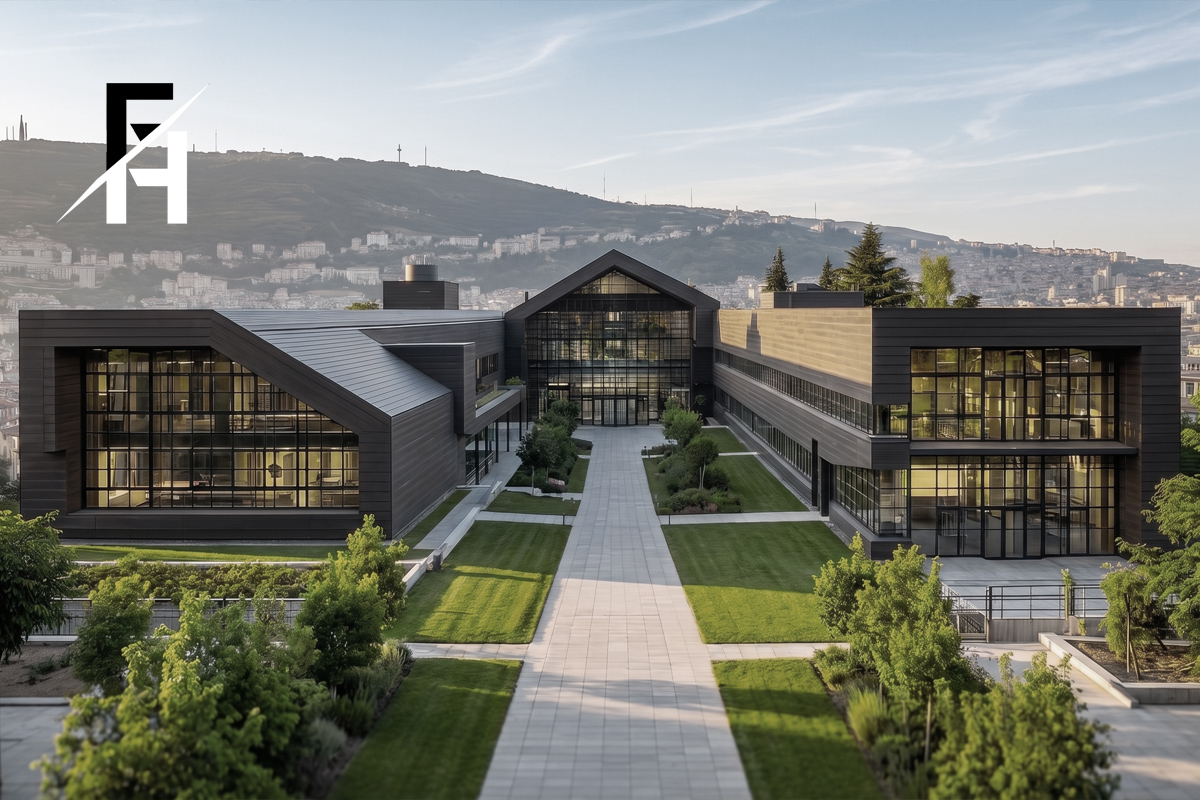
There is a category of industrial infrastructure that almost every mid-sized manufacturer wants, and almost none can justify alone.
A proper reception. A showroom that does not embarrass you when a German buyer arrives. A training room that can host twenty people. A canteen worth eating in. Structured HR, compliance and energy management. A logistics operation that runs at a sensible scale rather than a wasteful one.
Each of these costs roughly the same whether one company uses it or five. That single fact is the entire economic basis of the shared industrial campus.
What is shared, and what is not
The distinction is the model. Get it wrong and the whole thing collapses into a business park with a common car park.
Shared: reception and access control, energy and connectivity, logistics and loading, meeting and training space, canteen and welfare, showroom and visitor route, HR and compliance infrastructure, facility management.
Not shared, ever: the production process, the commercial relationship, the brand, the workforce, the customer list.
A multi-company industrial site works because the second list stays untouched. Companies do not merge, do not share customers and do not blur identity. They share the cost of everything that was never a competitive advantage in the first place.
A reception desk has never won anyone a contract. But not having one has lost a few.
The numbers, stated honestly
In a cluster of five SMEs of around fifty employees each, sharing HR, accounting, compliance, IT and marketing infrastructure generates estimated savings of €60,000–100,000 per company per year — €300,000 to €500,000 in aggregate.
This is an internal FabricaFuturo estimate, based on Italian industrial district benchmarks and consortium service cooperatives. It is not a measured figure from a controlled study, and we present it as an estimate rather than a finding.
We flag it that way deliberately, because the sector has a habit of quoting savings numbers with more confidence than their derivation supports. The order of magnitude is reliable. The precision is not.
What is better evidenced is the asset side. Industrial sites with structured shared services and ESG certification attract a wider institutional buyer pool, and funds screening industrial real estate apply 25–40 structured criteria before entering due diligence (CBRE Investment Management; Prologis ESG Framework). A site that already operates as a managed environment passes more of those criteria than one that is simply occupied.
Three starting points, three configurations
The question is never which model is best. It is which constraint is binding.
Underused square metres on a site you own. This is the Factory Hotel: a single industrial site hosting several companies, with shared infrastructure and services, where the owner takes rent and service revenue from the other occupants. The constraint it solves is capacity you are paying for and not using.
A supply chain that is too fragile or too far. This is the Factory Nursery: an existing site turned into an environment where smaller manufacturers find space, services and proximity to grow. The difference from an incubator is that the companies are producing, not prototyping. The difference from a straightforward multi-tenant site is directionality — the host has a strategic interest in who grows inside it, because those companies are its supply chain, its talent pool, or its future acquisition targets.
A site that works operationally but attracts nobody. This is the single-owner transformation, where the question is not tenants but what the site does for the company that already occupies it.
What the owner actually takes on
This is the part that gets skipped in the enthusiasm, and it is the part that determines whether the model works.
A shared industrial campus is a service business operating inside a building. The owner is no longer only a manufacturer with spare space. They are running access control, bookings, shared services, billing, dispute resolution between occupants, and a facility management function with real SLAs.
Three consequences follow, and all three are design decisions rather than operational ones:
It needs a platform, not a spreadsheet. Access, bookings, service consumption and billing across multiple independent companies is not a thing a facilities manager runs from email. This is the operational reason the digital layer exists in our method — not a technology preference.
It needs a governance structure before the first tenant. Who decides on shared investment. How costs are allocated. What happens when one occupant grows and needs more space than the arrangement anticipated. These are contract questions, and they are far cheaper to settle in advance than in a dispute.
It needs separation that is physical, not procedural. Production areas separated contractually but not physically generate a steady stream of friction that eventually poisons the arrangement. The separation has to be built.
Why this is becoming more viable, not less
Two structural shifts.
The first is cost. Industrial construction and energy costs have risen to a point where the infrastructure an SME would once have built alone is now out of reach alone. Sharing is no longer an optimisation; for a certain size of company it is the only route to facilities that the market now expects.
The second is capital. The shared campus with structured services and certified performance reads, to an institutional investor, as a managed asset with recurring revenue rather than a building with a tenant. That is a different asset class, with a different buyer pool and a different multiple — and the first movers in a category that does not yet have a standard classification tend to set its terms.
The honest limitation
The model does not suit everyone, and it is worth being direct about who it does not suit.
It does not work for companies whose process genuinely requires isolation — certain regulated pharmaceutical, defence and food production. It does not work where the owner wants rental income without operational involvement, because the service layer is what makes it function and the service layer requires management. And it does not work in the absence of a genuine anchor: a campus assembled from five tenants of equal size and no common interest tends to behave like five separate problems.
Where it does work, it works because the constraint it removes was never a competitive one.
Sources: CBRE Investment Management · Prologis ESG Framework · Confindustria industrial district data · internal FabricaFuturo estimates, declared as such. Figures verified October 2026.